The Invite (2026) Movie Review: A Sharp Comedy About Marriage and Desire
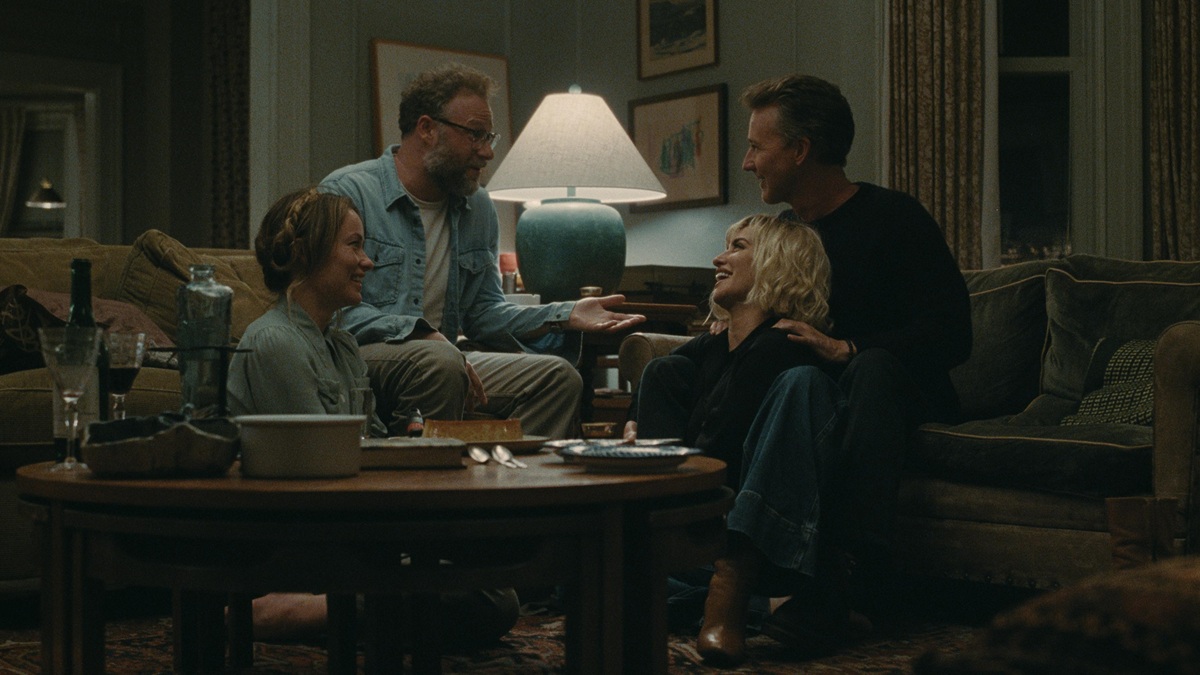
Movie Review: The Invite (2026) Is a Sharp, Uncomfortable Look at Love, Marriage and Desire
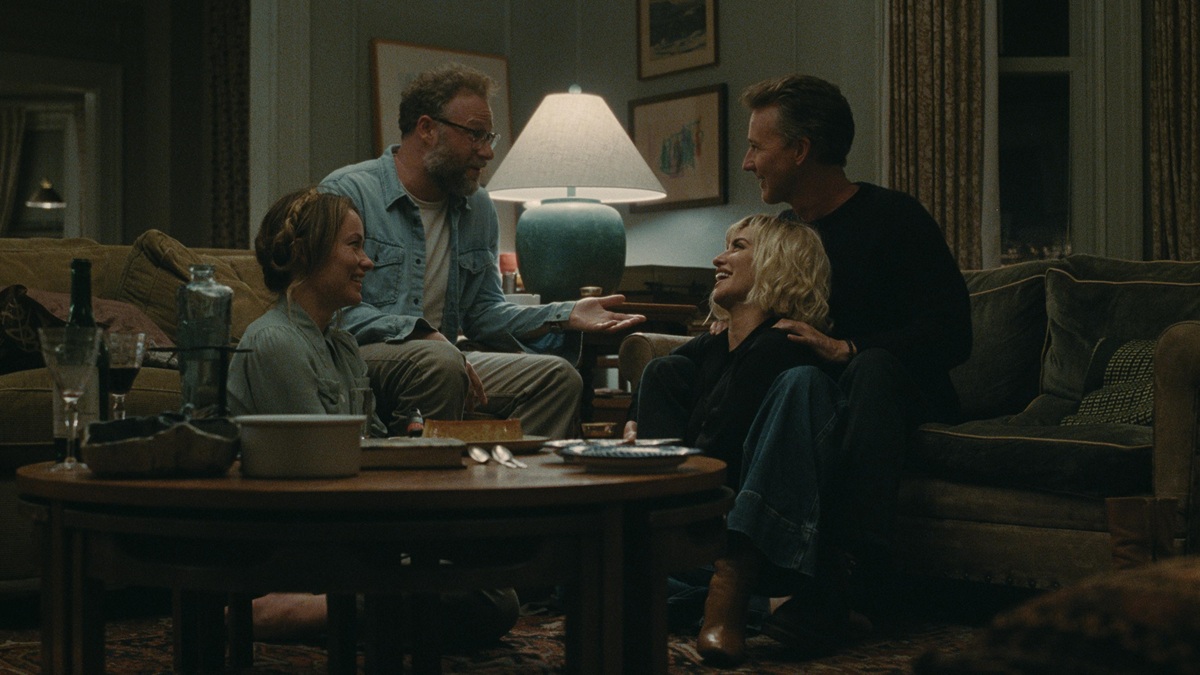
A scene from ‘The Invite’ (Photo: A24, 2026).
The Invite (2026) takes a simple dinner invitation and turns it into an unexpectedly revealing examination of relationships, jealousy, intimacy, and the quiet resentment that can build between two people who have been together for too long.
Directed by Olivia Wilde, the film brings together Seth Rogen, Penélope Cruz, Edward Norton, and Wilde herself for a mostly intimate story that unfolds around one increasingly complicated evening. What begins as a casual dinner between neighbors gradually becomes a confrontation with the uncomfortable truths that two couples would probably rather leave unspoken.
The result is an adult comedy with plenty of awkward humor, but beneath its jokes is something more serious. The Invite is ultimately about people wondering whether they are unhappy because they chose the wrong person or because they have slowly become unhappy versions of themselves.
A Dinner Party With Complications
Joe and Angela appear to have a comfortable life in San Francisco. They have a beautiful apartment, a long-term relationship, and the kind of domestic routine that looks stable from the outside.
But their relationship has clearly lost some of its spark.
Angela has spent months renovating their apartment, seemingly determined to create a home that looks as impressive as the life she wants people to believe they have. Joe sees things differently. He is tired, cynical, and increasingly disconnected from the world around him.
When Angela unexpectedly invites their upstairs neighbors for dinner, Joe is less than enthusiastic.
The neighbors are Piña and Hawk, a couple who seem to have everything Joe and Angela have lost. They are confident, attractive, relaxed, and openly comfortable discussing their relationship. They also happen to practice non-monogamy.
That revelation changes the entire atmosphere of the evening.
What starts as an ordinary dinner suddenly becomes a conversation about whether Joe and Angela might be willing to explore a completely different kind of relationship. But the more the four characters talk, the clearer it becomes that the real issue isn't simply whether they should sleep with other people.
The real question is whether they are happy with the people they have become.
Seth Rogen Gives Joe More Depth Than Expected
Seth Rogen is perfectly suited to playing Joe on the surface.
He is sarcastic. He is uncomfortable. He has a joke ready whenever a conversation gets too personal. His natural comic timing makes Joe entertaining even when his behavior becomes frustrating.
But Rogen's performance becomes more interesting as the evening progresses.
Joe isn't simply a man who doesn't like his wife or his neighbors. He is someone who feels that his life has moved in a direction he never intended. He once had ambitions as a musician, but now teaches music while dealing with depression and a growing sense of disappointment.
His biggest problem is that he has become comfortable blaming everyone else.
Joe believes Angela is responsible for the life he doesn't enjoy, yet the film quietly suggests that he has also played a role in creating that life. His sarcasm protects him from vulnerability, but it also prevents him from having an honest conversation with the person closest to him.
Rogen handles that contradiction surprisingly well.
Joe can be genuinely unhappy while still being unfair. He can deserve sympathy without always behaving sympathetically. That makes him feel less like a typical romantic comedy character and more like a real person who has allowed frustration to become part of his personality.
Olivia Wilde's Angela Wants More Than a New Relationship
Angela is presented as the more enthusiastic half of the couple, but Wilde gives her character a complicated emotional foundation.
Her fascination with Piña and Hawk isn't simply about attraction.
She sees something in them that she believes she and Joe have lost. They appear spontaneous. They communicate openly. They seem comfortable discussing subjects that would make most couples uncomfortable.
For Angela, their relationship represents the possibility of another life.
The film's apartment becomes an important part of that idea. Angela has spent months transforming the space around her, creating something beautiful and carefully designed. Yet the relationship inside that apartment remains unfinished.
She can repaint walls and change furniture.
She cannot renovate a marriage.
That contrast gives the film some of its strongest visual storytelling. Angela has control over her surroundings, but she has far less control over Joe, herself, or the history they have built together.
Wilde's performance works particularly well when Angela's confidence begins to crack. She wants to appear open-minded and adventurous, but underneath that confidence is a woman who is afraid that her best years may already be behind her.
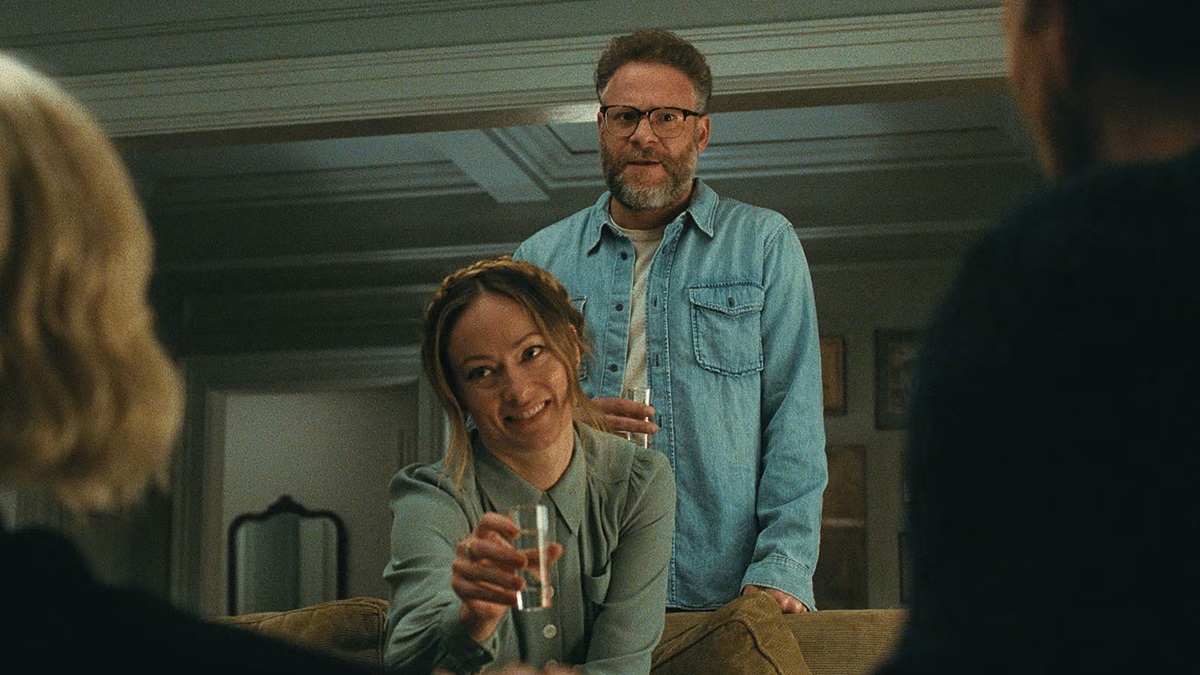
Olivia Wilde and Seth Rogen scene from ‘The Invite’ (Photo: A24, 2026).
Penélope Cruz Brings Electricity to the Film
The movie becomes much more entertaining once Piña and Hawk arrive.
Penélope Cruz gives Piña an unpredictable energy that immediately changes the balance of the room. As a sexologist, Piña is comfortable talking about intimacy, desire, and relationships in ways that make Joe increasingly uncomfortable.
But she isn't simply there to represent sexual freedom.
Piña has insecurities of her own.
Her openness doesn't mean she has solved the problems that come with jealousy, insecurity, or emotional attachment. The more the evening progresses, the more the film challenges the idea that a non-traditional relationship automatically means a healthier relationship.
Cruz makes Piña fascinating because she can be warm and intrusive at the same time. She seems to understand everyone in the room, yet there are moments when it becomes clear that she may not understand herself as well as she thinks.
Edward Norton Plays the Quietest Character in the Room
Edward Norton takes a more restrained approach as Hawk.
Compared with Piña, Hawk initially appears almost too calm. He doesn't seem particularly interested in creating conflict, and his relaxed personality makes him appear like the emotionally mature person at the table.
But that calmness doesn't last forever.
Norton gradually reveals that Hawk has his own complicated relationship with vulnerability and desire. His character isn't simply the wise neighbor who arrives to teach Joe and Angela how to live.
Instead, he becomes another example of the film's central idea.
Nobody has figured everything out.
Every relationship has its own rules, compromises, insecurities, and secrets. The difference is simply how openly people choose to discuss them.
The chemistry between Norton and Cruz works particularly well because their characters feel different from Joe and Angela without feeling unrealistically perfect.
Advertisement
The Film's Best Moments Happen Around the Dinner Table
The strongest part of The Invite is undoubtedly its central dinner sequence.
Once all four characters are together, the movie finds its rhythm.
The conversations move between comedy and discomfort. A joke can suddenly become an accusation. A seemingly innocent question can expose years of resentment.
The characters constantly change alliances.
Joe and Hawk connect.
Angela becomes fascinated by Piña.
Then the dynamics shift again.
The result is a constantly changing emotional battlefield where nobody is completely innocent and nobody is entirely wrong.
The film understands something important about long-term relationships: couples often know exactly which words will hurt each other.
Joe and Angela have clearly spent years learning each other's weaknesses. Their arguments are not dramatic explosions at first. They are small comments, sarcastic remarks, and seemingly harmless observations that carry years of emotional history.
That is where the screenplay is at its best.
The movie doesn't need to explain that their marriage is struggling.
You can hear it in the way they talk to each other.
Non-Monogamy Is Only the Beginning of the Conversation
The central idea of The Invite could easily have turned into a predictable debate about monogamy.
Thankfully, the movie goes further.
Piña and Hawk's relationship isn't presented as the perfect alternative to traditional marriage. Their openness comes with its own complications, and their confidence begins to look less absolute as the evening continues.
This is one of the film's more interesting observations.
Changing the rules of a relationship doesn't necessarily solve the problems inside it.
If a couple is jealous, insecure, unhappy, or emotionally disconnected, simply changing the relationship structure won't automatically make those feelings disappear.
Joe and Angela aren't necessarily attracted to the idea of another relationship because they genuinely want an open marriage.
They may simply want an escape.
And there is a major difference between wanting freedom and wanting to run away.
The film uses Piña and Hawk as a mirror for Joe and Angela. They represent a different possibility, but they also reveal that every relationship comes with its own complications.
Olivia Wilde Finds Her Strength in the Smaller Story
As a director, Olivia Wilde seems much more comfortable when the film focuses on character rather than spectacle.
The Invite is a contained story, but Wilde keeps the apartment visually interesting. Characters move between rooms, conversations happen in private corners, and the physical space constantly changes depending on who is speaking to whom.
The apartment starts as a symbol of Angela's carefully constructed life.
By the end of the night, it feels almost like a pressure cooker.
The confined setting also gives the actors room to dominate the film. The camera doesn't need to constantly search for something bigger because the real drama is happening between four people sitting in the same home.
The film's visual style also gives the story a warm, cinematic quality that suits its intimate subject matter.
The Humor Works Best When It Feels Uncomfortable
The Invite is funny, but it isn't a conventional comedy.
Its best jokes come from awkwardness.
Joe's discomfort is often hilarious because he is clearly trying to maintain control while everything around him becomes increasingly unpredictable. Angela's attempts to keep the evening civilized become funnier as her carefully planned dinner falls apart.
The humor comes from watching people struggle to behave normally while discussing things that most couples would prefer to keep private.
That gives the film an appealing adult tone.
It isn't afraid to make its characters embarrassing.
It also isn't afraid to let them be petty.
Sometimes the funniest moments are also the moments that reveal the most about the characters.

Seth Rogen in a scene from ‘The Invite’ (Photo: A24, 2026).
Where The Invite Loses Some Momentum
The movie isn't perfect.
The first section takes a little too long to establish what the audience can already understand. Joe and Angela's unhappiness is obvious early on, and the film occasionally repeats the point before allowing the characters to simply interact.
The story also begins to feel slightly overextended toward the middle.
The central conversations remain interesting, but some of the arguments begin circling familiar territory. A tighter edit could have made the dinner party feel more unpredictable and intense.
The biggest weakness arrives toward the final act.
After spending much of its runtime exploring complicated questions about marriage, desire, jealousy, and regret, the movie begins moving toward a safer conclusion.
Some of the characters suddenly become more emotionally articulate than they have been throughout the evening.
The film seems to want to give everyone a clear emotional answer when its most interesting quality was the uncertainty.
A more ambiguous ending might have suited the story better.
Final Verdict
The Invite (2026) is an engaging adult comedy that uses one uncomfortable dinner party to explore much bigger questions about relationships.
The film is at its strongest when it allows its four characters to be complicated, selfish, insecure, funny, and occasionally cruel. Seth Rogen delivers a surprisingly layered performance, Olivia Wilde gives Angela emotional vulnerability, while Penélope Cruz and Edward Norton bring a different kind of energy that keeps the central dinner from becoming predictable.
The movie's biggest strength is that it doesn't treat non-monogamy as a simple solution to relationship problems. Instead, it asks a more difficult question: are people unhappy because they are with the wrong person, or because they have stopped being honest with themselves?
That question gives The Invite more staying power than its premise initially suggests.
It may not completely stick the landing, but for much of its runtime, the film is funny, uncomfortable, and surprisingly perceptive.
If you enjoy relationship dramas with dark humor, sharp dialogue, and strong ensemble performances, The Invite is worth adding to your 2026 movie watchlist.
Rating: 7.5/10
Best for: Fans of relationship comedies, adult dramas, uncomfortable dinner-party movies, and character-driven stories.
Watch if you like: Films that mix humor with serious conversations about love, marriage, jealousy, and intimacy.
Advertisement
Comments
to leave a comment.
Advertisement